
WhatsApp Chatbot Pricing in 2026: Real Cost Breakdown
What does a WhatsApp chatbot actually cost in 2026? API fees, hosting, and SaaS plans compared. See the full cost breakdown before you commit.
"How much does a WhatsApp chatbot cost?" is the question every buyer asks and almost no vendor answers clearly. The reason is that the real cost depends on which route you take — and the three routes (Business API, self-hosting, no-code SaaS) have wildly different price tags and hidden fees.
This guide breaks down all three so you can budget honestly. For a broader comparison of tools, pair it with our best WhatsApp chatbot tools ranking.
Watch a 1-minute build
The three cost models at a glance
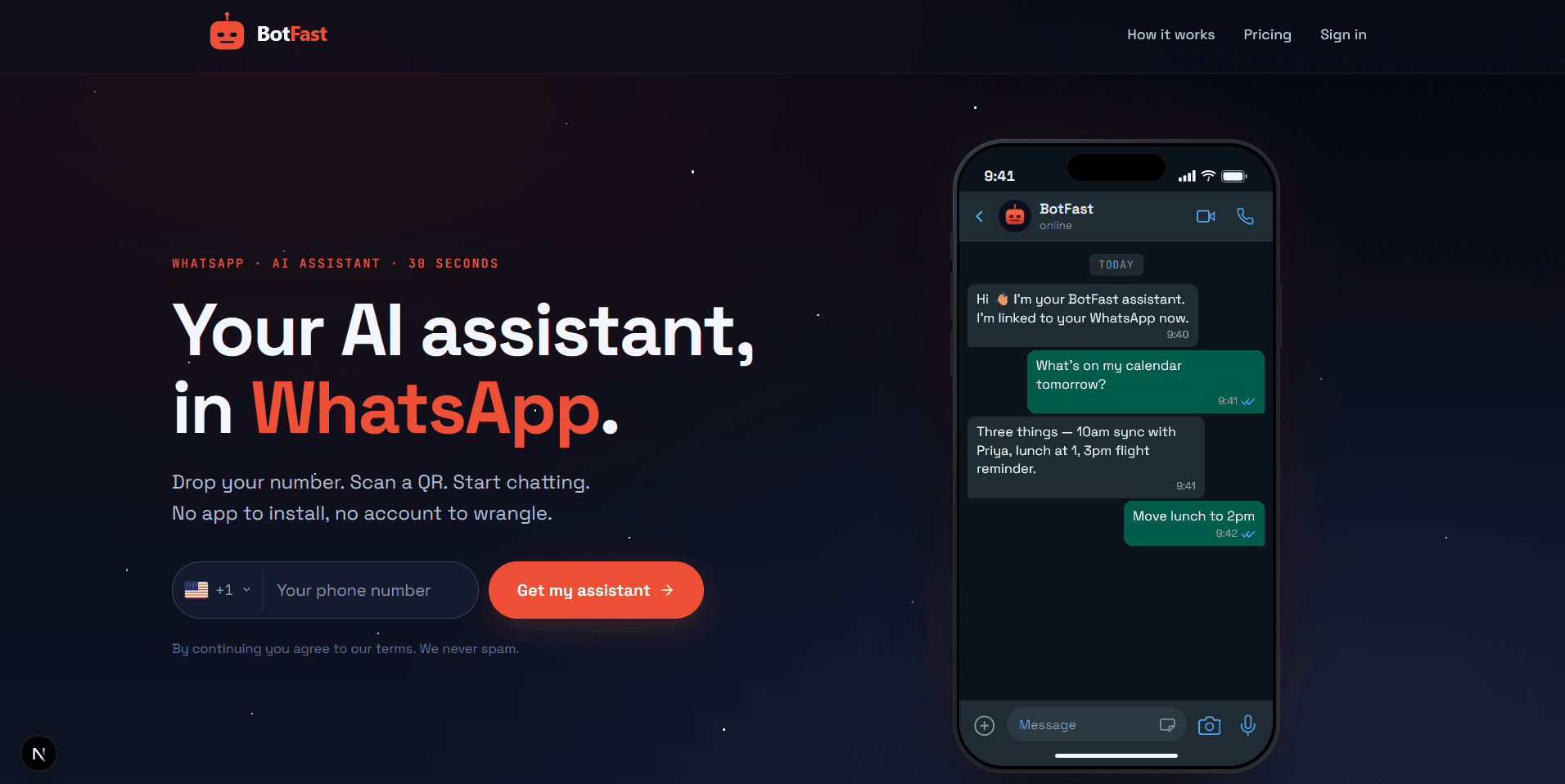
Most WhatsApp chatbot pricing journeys start here — a free trial that reveals whether the tool fits before you pay anything
| Route | Monthly cost | Setup | Per-message fee |
|---|---|---|---|
| WhatsApp Business API (Wati, Twilio) | $39–$1,000s | Days, approval | Yes (per conversation) |
| Self-hosted (Baileys + VPS) | $5–$20 | 1–3 dev days | No |
| No-code SaaS (BotFast) | $9–$99 | 30 seconds | No |
Meta Business API costs
The official WhatsApp Business API charges per 24-hour conversation, not per message. Each conversation falls into a category with different pricing:
- Service conversations — initiated by the customer messaging you. Often the cheapest tier.
- Utility — account updates, confirmations, post-purchase.
- Authentication — one-time passcodes.
- Marketing — promotions and campaigns. The most expensive tier.
Exact rates vary by country and shift over time, so check Meta's current rate card. On top of per-conversation fees you usually pay for a BSP (Business Solution Provider) like Wati or Twilio, which adds a platform subscription. This route makes sense at scale; it is overkill for a solo business.
Two subtleties catch buyers out. First, the 24-hour conversation window resets per user — every time a customer messages you, you can reply freely for 24 hours, but marketing or utility messages sent outside that window each consume a fresh (chargeable) conversation. A poorly timed broadcast can therefore cost far more than the per-message rate suggests. Second, the first 1,000 service conversations per month are free under Meta's current terms, which softens the bill for inbound-heavy support lines but does nothing for outbound marketing. If your workload is mostly you replying to inbound customer questions, the API can be surprisingly affordable; if it is mostly you pushing promotions, budget for the marketing tier in every estimate.
Self-hosting costs
If you are technical, you can run a WhatsApp bot on a cheap VPS using an open-source library like Baileys (which is what BotFast is built on, under the hood). The recurring costs:
- VPS: $5–$20/month depending on specs and region.
- Domain + SSL: ~$10/year.
- Optional managed Postgres: $0–$20/month (or self-managed for free).
The hidden cost is your time. WhatsApp routinely breaks unofficial clients, reconnections need handling, credentials need secure storage, and library updates land on your plate. Realistically, budget 1–3 days to launch and ongoing hours per month for maintenance. For the full picture, read our how to build a WhatsApp chatbot guide.
There is also a stability tax that does not show up on any invoice. Unofficial libraries ride on WhatsApp's internal signalling, so when Meta changes the protocol your bot can go offline for hours or days until a patch ships — and if your number gets flagged for unusual automation patterns, you can lose the session entirely. Many teams "save" the $9–$30 SaaS fee only to spend a developer afternoon every few weeks firefighting reconnections, which at any normal hourly rate dwarfs the subscription it replaced. Self-hosting is genuinely cheap only when you already have an engineer on payroll whose time is sunk cost; otherwise the maths rarely favours it.
No-code SaaS plan comparison
No-code tools bundle hosting, the WhatsApp connection, the AI, and the dashboard into one subscription. Here is how BotFast's plans break down (credits are the unit of AI usage — roughly 1 credit per 1,000 AI tokens):
| Plan | Price | Credits/month | Best for |
|---|---|---|---|
| Free trial | $0 | 500 | Testing every feature |
| Starter | $9/mo | 5,000 | Solo founders, light use |
| Pro | $30/mo | 25,000 | Active small business |
| Business | $99/mo | 100,000 | High-volume support |
No per-message fees, no Business API approval, and the credits cover chat, voice transcription, image understanding, web search, and document parsing. See the pricing page for current details.
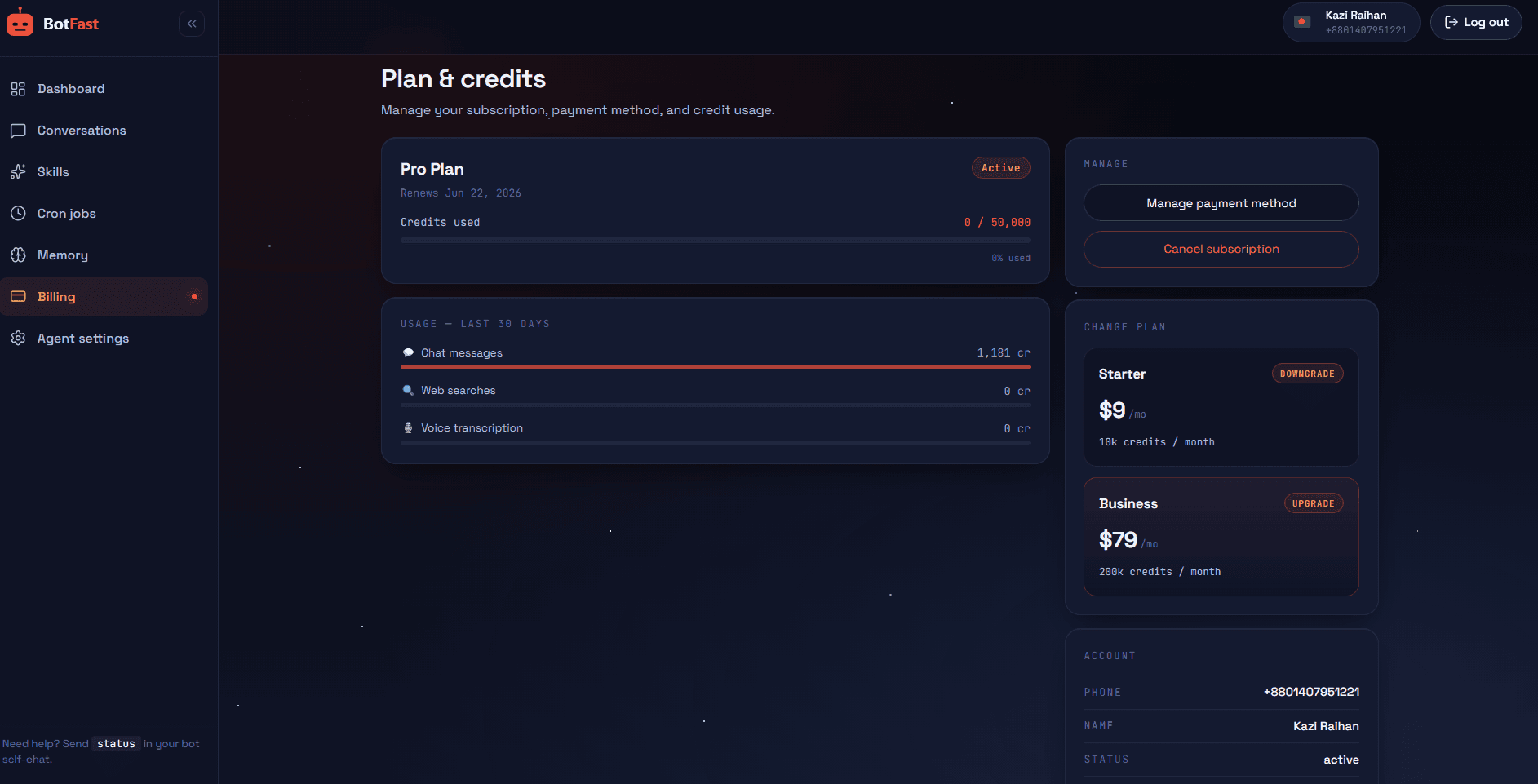
The billing dashboard shows exactly how many credits you have used — so there are no surprise overage charges on your WhatsApp chatbot pricing
Hidden costs to watch for
Business API: per-conversation fees, template approval overhead, and the cost of a separate inbox/CRM on top of the API itself.
Self-hosting: server, maintenance, reconnection handling, secure credential storage, and developer hours every time WhatsApp changes its protocol. This is the "iceberg" cost that makes the sticker price misleading.
No-code SaaS: usually the sticker price is close to the real price. Watch for credit overages, premium add-ons (better AI models, extra integrations), and seat fees for teams.
Pricing by use case
Abstract price ranges only get you so far. Below are realistic monthly estimates for five common WhatsApp chatbot workloads, modelled across all three routes. Treat these as planning anchors, not quotes — actual WhatsApp chatbot pricing depends on your country's Meta rate card and exact message mix.
| Use case | Business API | Self-hosted | No-code SaaS |
|---|---|---|---|
| Solo freelancer (~200 inbound chats/mo) | ~$39/mo + fees — overkill | ~$10 VPS + your time | $9/mo Starter |
| Small support team (~2,000 chats/mo) | ~$60–$120/mo with fees | ~$15 + heavy dev upkeep | $30/mo Pro |
| E-commerce store (order updates + FAQs) | ~$100–$250/mo | ~$20 + dev time | $30–$99/mo |
| Clinic booking (appointments + reminders) | ~$80–$200/mo (utility tier) | ~$15 + dev time | $30/mo Pro |
| High-volume marketing (10k+ outbound) | $300–$1,000s/mo | Risky / against ToS | Not the right fit |
The pattern is clear: for low-to-mid volume conversational work the no-code SaaS route is almost always the cheapest once you account for developer time, and the Business API only wins on cost once you are pushing large volumes of outbound marketing that SaaS tools are not built for. Cross-reference this with our best WhatsApp chatbot tools comparison to match each use case to the right product.
How to calculate your real cost
Vendors quote low sticker prices because most buyers never do the multiplication. Here is the four-step method we use to turn a headline number into a realistic monthly bill — it works for any of the three routes.
- Estimate monthly conversations or messages. Count unique customer-initiated threads for an inbound workload, or planned sends for outbound. Multiply your busiest week by four for a conservative monthly figure.
- Multiply by the per-conversation or per-credit rate.Use Meta's category rate for the API, or the SaaS credit cost (a credit ≈ 1,000 AI tokens). Apply the marketing tier to anything promotional — it is the most expensive.
- Add the platform fee. The BSP subscription (Wati, Twilio) or the SaaS base plan sits on top of usage. Add any seat fees for extra agents.
- Compare the totals across routes at your realistic volume, then add a 30% buffer for overages and growth. The route with the lowest total cost of ownership — not sticker price — is your answer.
A worked example for a small support team on a SaaS plan:
# WhatsApp chatbot pricing — worked example (SaaS route)
conversations_per_month = 2000
avg_credits_per_chat   = 6          # AI reply + context lookups
credits_needed         = 2000 * 6   # = 12,000 credits (fits comfortably in the 25k Pro plan)

plan                   = "Pro"      # $30/mo, 25,000 credits included
overage_credits        = 0          # within plan
platform_fee           = 30
seat_fees              = 0          # single user

monthly_total          = platform_fee + seat_fees + overage_credits
# monthly_total = 30  ->  about $0.015 per conversation

# Same workload on the Business API (utility tier, ~$0.02/conversation):
api_conversation_cost  = 2000 * 0.02   # = $40
bsp_subscription       = 39            # Wati-style base plan
api_monthly_total      = 40 + 39       # = $79
In this example the SaaS route comes in at roughly $30 versus $79 on the Business API — and that is before counting the engineering time the API path demands. Run the same block with your own numbers; the crossover where the API becomes cheaper usually sits well above 10,000 conversations a month, and only for outbound-heavy workloads.
When to upgrade plans
Most teams under-buy, hit limits, and then over-correct by jumping two tiers at once. The cleaner approach is to recognise the upgrade signals early. On a credit-based SaaS plan, the first signal is consistent overage: if you are burning through your monthly credits in three weeks for two months running, you are either paying overage rates (the most expensive way to buy credits) or throttling the bot — both of which cost you more than simply moving up a tier. The second signal is feature need: heavier models, longer memory, or team seats are usually gated to higher plans, and workarounds (like running two accounts) cost more than the upgrade.
Team growth is the other trigger. Once a second or third person needs their own seat, the per-seat economics flip and a higher tier that bundles seats starts to undercut the add-on seat fees. The same applies to scheduling and background jobs: if you are running dozens of cron tasks a day, the credits they consume can quietly push you past a plan boundary. Track usage in the dashboard rather than waiting for a failed message — the best WhatsApp chatbot tools all surface a usage chart precisely so you can upgrade on your schedule, not in the middle of a peak.
Finally, there is the break-even question: when does the Business API actually become cheaper than SaaS? The honest answer is "later than most people think." Because SaaS bundles hosting, the WhatsApp connection, the AI, and the dashboard into one flat fee, its effective per-conversation cost keeps falling as volume rises — right up until you outgrow what a linked-device tool can do (mainly large-scale opt-in marketing). Only at that point, typically tens of thousands of outbound conversations, does the API's lower marginal rate overcome its platform fees and setup cost. Below that line, upgrading within your SaaS plan is almost always the cheaper move.
Frequently asked questions
How much does a WhatsApp chatbot cost?
From free (self-hosted on a $10/month VPS, plus your time) to $9–$99 for no-code SaaS like BotFast, to thousands for high-volume Business API use. Most small businesses land in the $9–$30 SaaS range.
Does WhatsApp charge for messages?
Only on the Business API, which charges per 24-hour conversation by category and country. The linked-device route sends through your own number with no per-message fee.
Is there a free WhatsApp chatbot?
BotFast offers a free trial with credits and no card. Self-hosting Baileys is free in software but needs a server and developer time.
What are the hidden costs?
Business API: per-conversation fees and a separate inbox. Self-hosting: server, maintenance, and dev hours. No-code SaaS: usually the sticker price is close to the real price.